String is actually something you can choose to ignore totally and at the same time choose to pay a lot of attention to.
If you are a less-experienced or an intermediate player, the string doesn’t really matter that much.
If you don’t want to pay much attention on it, then just ask for the cheapest string or the most durable string. In the world of Yonex, it’s BG65.
Tension
One of the most common question is what tension I should use. A very basic guide is like this:
| Kgs | Lbs | |
| Less-experienced | 7.5-9 | 17-20 |
| Intermediate | 9-11 | 20-24 |
| Advanced | 11-12 | 24-27 |
| Professional | 12+ | 27+ |
It’s important that you know what string tension means. I’ve seen lots of people tend to string with very high tension, such as 12.5 kgs. Some of them didn’t even know that the tension they are requesting is actually already higher than the recommended max tension for the racket. If you string the racket with the tension higher than the recommended max tension, the racket can get broken, so it’s better to make sure you know the risk before requesting a high string tension on your racket.
Let’s get back to this table. This table does make some sense. Why?
Sweet spot
Sweet spot is the hitting area on your racket face that can best deliver power from your body, arm through the racket to the shuttle. Hitting a shuttle within the sweet spot of the racket face is the only way to hit a shot properly.
When the string tension is higher, the sweet spot is smaller. When the string tension is lower, the sweet spot is bigger.
As we talked in another post “Basics“, distance and timing are the keys to hit a shuttle properly. With a bigger sweet spot, you can tolerate a bit more error or deviation in distance and timing. This is why when your skill is still not enough, choosing lower string tension and having bigger sweet spot is a much more effective and smart decision.
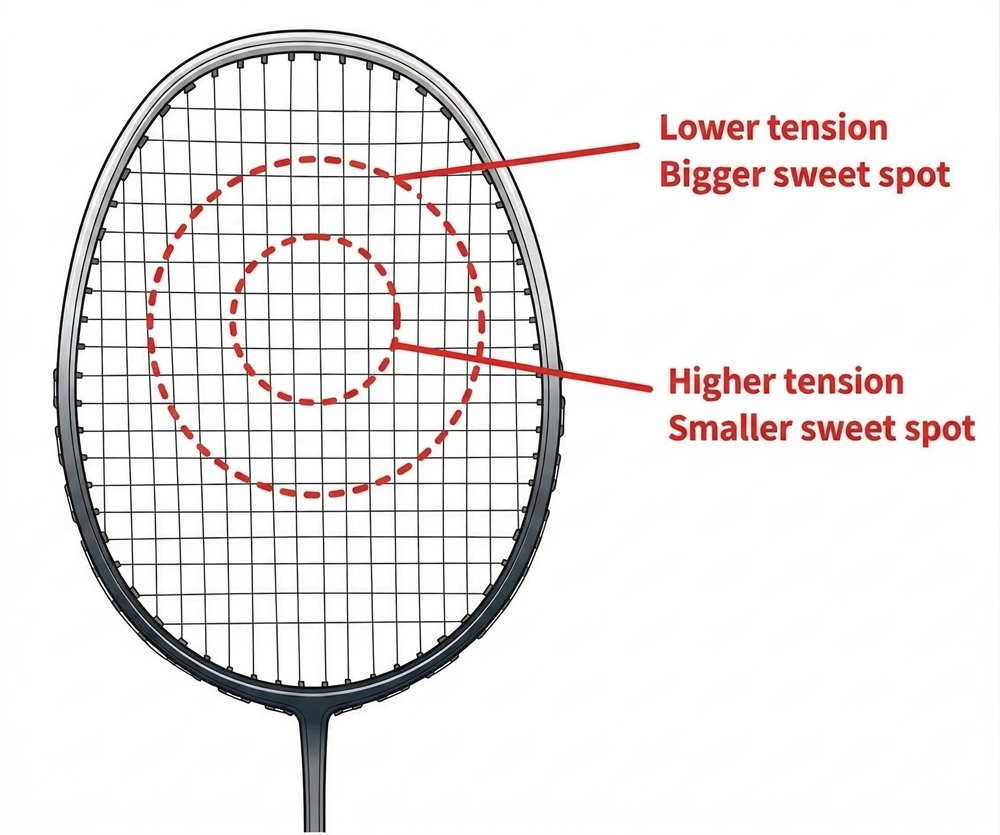
Again, when you are not able to have precise distance control and timing control yet, high string tension doesn’t help you in any ways.
By the way, there are 2 easy ways to see if you are regularly hitting the shuttle within the sweet spot. One is when you broke your string, you can see where the string got broken. Is it around the sweet spot or some where far from the sweet spot?
In this picture, you can see the string’s broken point is quite far from the sweet spot.
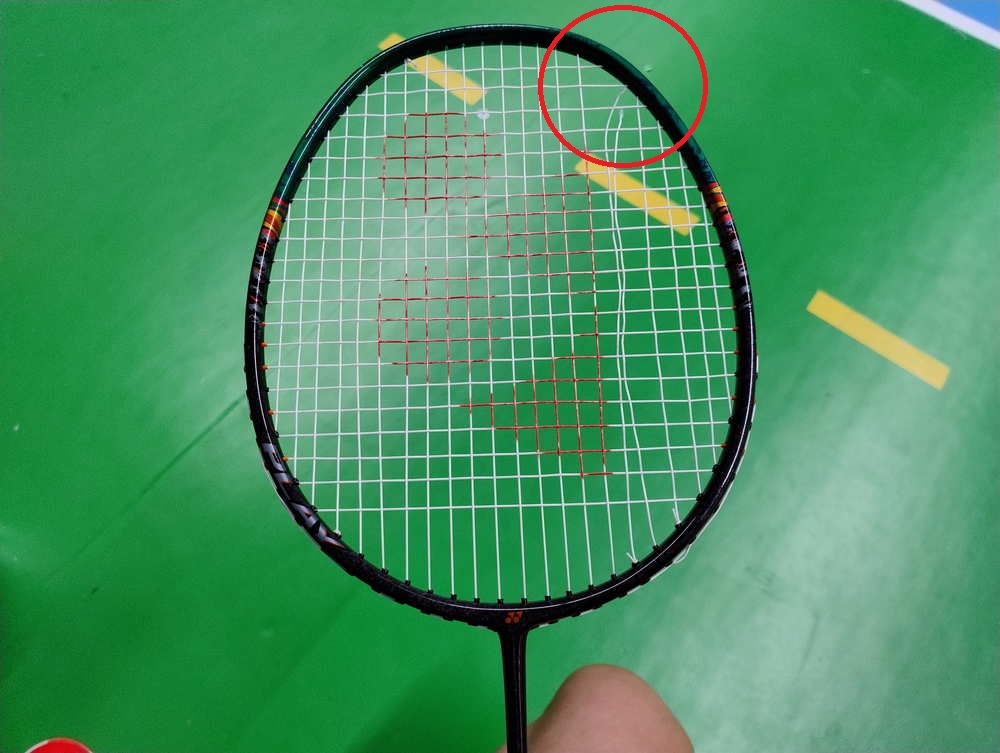
By the way, the string around the sweet spot can absorb vibration much better than the string close to the racket frame. So, if you hit the shuttle at the tip of your racket, the chance to break the string is much higher than hitting within the sweet spot.
The other way is to see where your strings are wearing out. If you have used the string for a few weeks, you can see the string is wearing out gradually with the threads coming out.
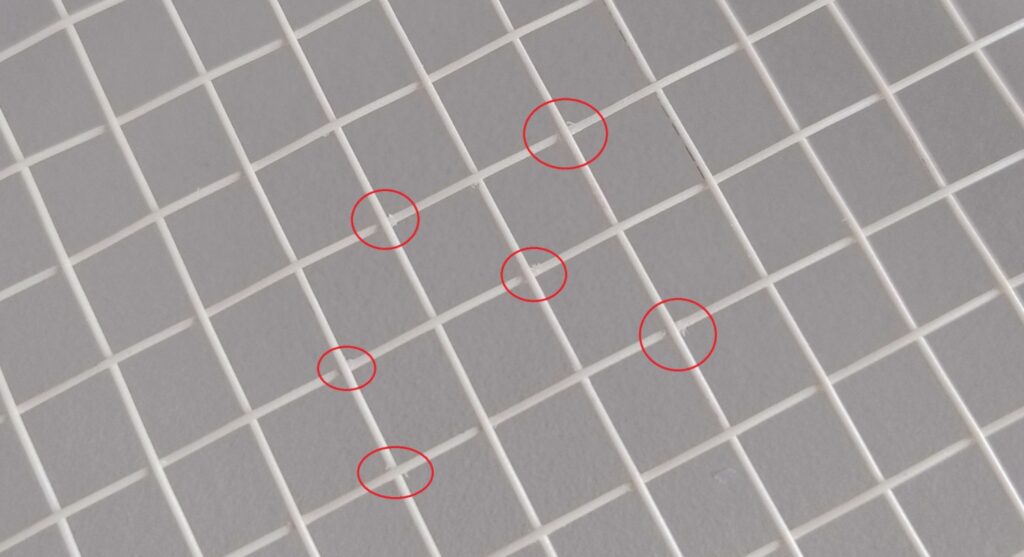
Then look at where are these wearing out points. Do they mostly locate in the sweet spot? Or they scatter around the racket face? If they mostly locate in a small area around the sweet spot, then your timing control and distance control is good. If they scatter in a bigger area or even outside of the sweet spot, then your timing and distance still need improvement.
Which string?
When choosing a string, it comes down to the 2 very basic dimensions: String Thickness and Price.
String thickness basically represents the trade-off of 2 features: Quick repulsion and durability. Quick repulsion means the shuttle can be bounced back faster. Many intermediate or advanced players love quick repulsion, because it brings faster speed in the games.
The thickness of a string can range from 0.61mm to 0.70mm. Thin string usually means faster repulsion, and thick string usually means better durability. For example, the famous durable string BG65 has thickness of 0.70mm. The popular quick repulsion string such as Exbolt 65 or Nanogy 98 has the thickness of 0.65mm and 0.66mm.
And yes, thanks to the technology, you can have both quick repulsion and durability on one string. Just need to pay more. (but not that much, roughly just 2 to 3 euros per racket string)
If you are a less-experienced player, I definitely recommend you choose durable strings. Because just one strong missed hit at the edge of the racket face can cost you the whole string (and money and time to restring it). Go for the quick-repulsion one only after you can properly hit the sweet spot regularly. Of course, if the few extra euros doesn’t matter to you, then just choose the strings that have both quick repulsion and durability.
For sure there is also difference between different string brands. I’ll skip this discussion for now since I have little experience.
Durability
Durability of a string depending on various factors. However, there are 3 the most important factors in my opinion affecting the life length of a string: String, Tension, Sweet spot.
The first one, String, means to choose a string that is featured for durability, such as BG65 in Yonex.
The second one is the string tension. Higher tension makes the string get broken easier. So, if you want more durability on your string, lower the tension of your string.
The third one is sweet spot. If you keep hitting the sweet spot, your string can last longer. If you are regularly missing the sweet spot, the life of your string can be shorter than expected.
Protect your wrist, elbow and shoulder
The last one is about your wrist, elbow and shoulder. Surprisingly, string also plays an important role in protecting your wrist, elbow and shoulder. I realized this with my own body and my tennis elbow.
Whenever we swing the racket to hit a shuttle, there is vibration and shock wave transmitted from the string to the racket to our wrist to the elbow and to the shoulder, especially in Smash or other powerful shots.
String itself and string tension play the key roles in shock absorption.
Depending on the structure or materials used, some strings have higher shock absorption capability. So, if you have some pain or discomfort in your wrist, elbow or shoulder, choose the ones that feature good shock absorption.
String tension and shock absorption is as easy one to imagine. Lower tension makes the racket face softer. Higher tension makes the racket face harder. You can just imagine that you put a sponge on your racket face or put an iron plate on your racket face, and use it to hit a shuttle. For sure you will feel less vibration with the sponge and big vibration with the iron plate. Then, again, if you want to protect your wrist, elbow and shoulder, lower the tension of the sting is a good decision.
Additionally, nothing about the string, but if you want to protect your wrist, elbow and shoulder more, adding soft wrapping tape under the grip tape is one good way to reinforce the shock absorption.
Leave a Reply