Starting from conclusion. The KEY basic skills of badminton all come from these three: DISTANCE, TIMING and RACKET FACING DIRECTION
In another word, all basic skills can be condensed into these three.
The basic shots in badminton include Drive, Lift, Drop, Clear, Smash and Net Shot.
- Drive: A flat, fast, and powerful shot hit horizontally over the net to put pressure on the opponent and limit their attacking options.
- Lift: A high, deep defensive shot hit from the forecourt to the opponent’s backcourt, usually to gain time when under pressure at the net.
- Drop: A delicate, downward-aimed shot hit from the backcourt that falls steeply and lands just past the net to force the opponent forward.
- Clear: A high, arching shot hit to the back of the opponent’s court to reset the rally or push them away from the center.
- Smash: The primary attacking shot, hit with maximum power and a steep downward angle to overwhelm the opponent’s defense.
- Net Shot: A soft, controlled shot hit from the net area that barely clears the tape and falls vertically to catch the opponent off guard.
When talking about the skills and techniques of badminton, there can be really TONS of details, and sometimes (or most of the time) they can be overwhelming. While most people know and talk about some of the details, you may also feel “Oh, I know that. I’ve heard that many times.”
But again, everything can be the result from DISTANCE, TIMING and RACKET FACING DIRECTION.
No matter it’s overhead shots such as Clear, Smash or Drop, no matter it’s under-hand shots like Lift or some Net Shots, or shoulder-height shots: Drive and some Net Shots, they all rely on your sense of distance and sense of timing.
Distance
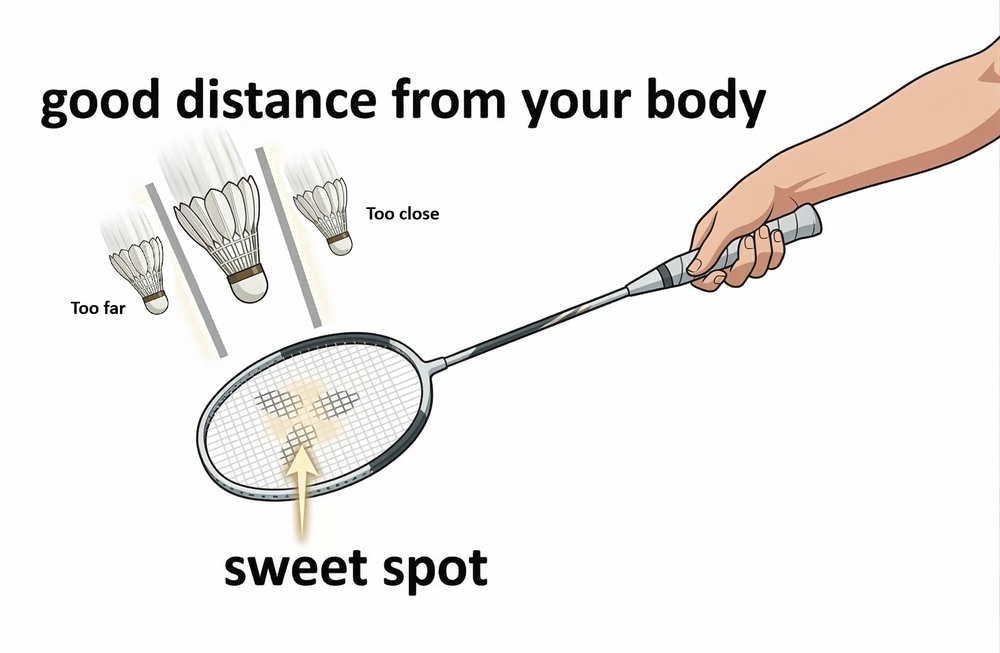
If your body is too close to the shuttle, there is no way you can hit the shuttle well, no matter you are doing a Drop or a Net Shop or a Clear.
Same thing, if your body is too far from the shuttle, there is no way you can hit the shuttle well, no matter you are doing a Smash, a Drop or a Lift.
There is a range of distance that you can do the shot properly. Inside this range means the shuttle is not too far nor too close to your body.
Then, how to keep (or move) your body inside this range so that you can have proper distance between your body and the shuttle? First is footwork and the second is adjustment of your arm.
Inefficient footwork makes you move slowly on the court, which results in the “too-far distance” between your body and the shuttle. How to make your footwork more efficient? There is no shortcuts: muscle training + footwork pattern practice. Both you can find a lot of information or videos on the internet or ask Gemini.
By the way, too-efficient footwork can also happen. Maybe mostly to the younger players who can move very fast (too fast as a result) but are still lack of experience to feel the proper distance.
Less-experienced players tend to use their arms to adjust the distance (maybe up to 15cm), sometimes by extending their arms and sometimes by squeezing their arms. Both not correct and both not recommended. When you are getting better, reducing using arms for distance adjustment to 2 to 3 cm is important.
Timing
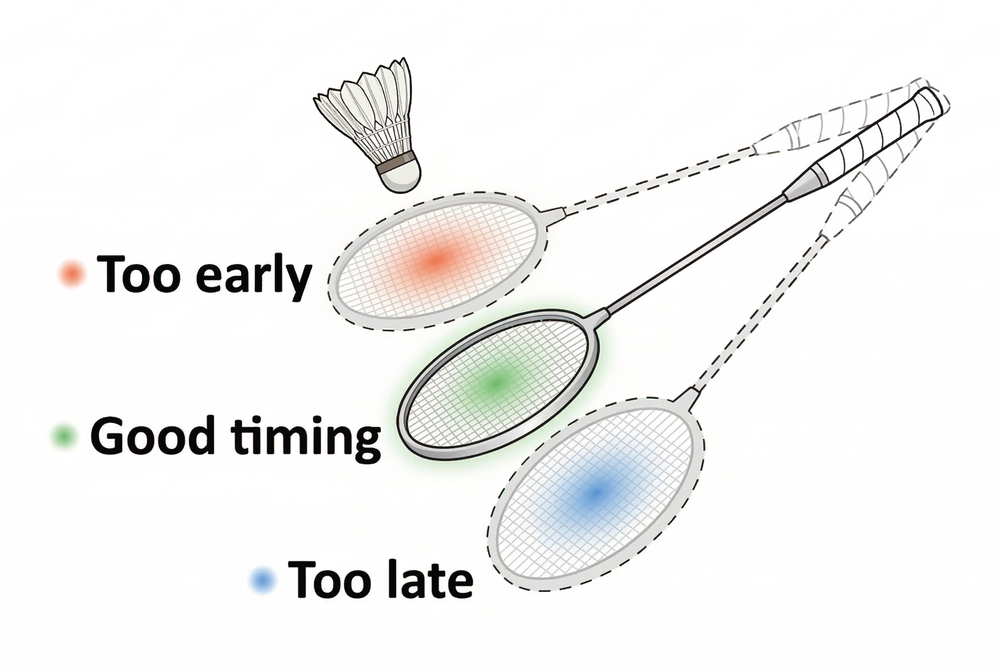
We can also say “Timing” as “Rhythm.” Some people also say badminton is a rhythm sport. You probably can also notice that those who have good sense of rhythm also have a better start in badminton.
Again, no matter it’s a Drop, a Smash, a Clear, too-fast timing can make you miss the shuttle, or simply make the shuttle end up higher than you expected.
When the timing is too late, no matter it’s a Net Shot, a Drive or a Lift, the shuttle goes too high or too low (then can’t pass the net) than you expected.
Same thing, there is also a range of timing to make it possible to do a shot properly.
When doing a Lift, if the timing is too early, then the Lift will be very high and not far enough. If the timing is too late, then the Lift will be low and maybe too far (or just ends up at the net). When doing a Drive, if the timing is too early, then the shuttle ends up at the net. If the timing is too late, then the shuttle goes high and give the opponent a great chance to give pressure on you.
The sense of timing (or rhythm) can be gifted when you are born, and it can also be trained of course. The important tip is to think the every shot you hit is too early or too late. (good to also think the distance: is it too far or too close?)
Racket facing direction
The last one is a easy one and also a difficult one: Racket facing direction. There is also a way how coaches talk about it, which is more familiar to you: GRIP.
There are also forehand grip and backhand grip, which is talking about how to deliver power more easily at different shuttle positions. But the grip we talk here in general is all about racket facing direction.
No matter you are talking about grip or racket facing direction, it’s all about making the angle of your racket face correct.
When you do overhead shots like Drop, Smash or Clear, it’s quite difficult to see if you have your racket face angle correct or not, because first you are focusing on and looking at the shuttle, and second you don’t really see your racket when you swing it.
But when you do Drive, Net Shot or Lift, it’s much easier to see if you have your racket face angle good or not, because the racket is in front of you and you can observe your racket during swinging.
The good news is you don’t need to go to gym and you don’t need to do very physically tough thing to improve it.
The bad news is it’s difficult to change your habit. When you have been holding the racket the wrong way for years, it’s not that easy to change your habit, especially when you are playing a game and all your focus and consciousness are on the shuttle but not how you hold the racket.
Tips
There is no magic. How I do it is I try to think and review each shot I just did.
- Is it too close?
- Is it too far?
- Is it too early?
- Is it too late?
Then adjust it a bit in the next shot.
I also try to feel the hitting point on my racket face in every shot. This is a bit more precise adjustment for the timing and distance.
- It feels like I hit the sweet spot of the racket face.
- It feels like I hit the bottom part of the racket face.
- It feels like I hit the tip part of the racket face.
- It feels like I didn’t hit the sweet spot of the racket face.
Then adjust the timing slightly in the next shot.
Leave a Reply to String – Wisdom of Badminton Cancel reply